Eimi TAGORE
- TOP >
- Archives >
- Residency Program >
- Eimi TAGORE
Curator Residency Program
update: 2025.9.9
Eimi TAGORE
| Participating Project | Curator Residency Program |
|---|---|
| Activity Base | San Francisco, New York |
| City / Place stayed | Tokyo |
| Period | 2025.9 - 2025.10 |
Purpose of the residency
My dissertation "Crisis and Collectivity: Cartographies of Contemporary Transpacific Art," maps artists exploring the interconnectedness of US and Japanese imperialism in the Pacific. During this four-week residency, I will conduct research and writing in support of my project, examining alternative notions of collectivity shaping the practices of Japanese contemporary artists to supplement my chapter on emergent forms of belonging, while also researching the history of Japanese emigration to Hawai’i. My aim is to move away from nation-based structures of identity to more unconventional modes of belonging that reflect transpacific conditions and histories.
Plan during the residency
• Conduct studio visits and interviews with artist collectives and duos based in the Kanto area to learn about the origins and
ambitions
of their collective practice.
• Visit Hiroshima to interview Yellow River College collective and observe their activities.
• Research Japanese emigration to Hawai‘i at the Hawai‘i Emigration Museum (Yamaguchi) and related archives in Hiroshima.
• Attend exhibitions and performances in Tokyo to document emergent forms of collectivity.
• Dedicate time to dissertation writing, focusing on the chapter on emergent forms of belonging.
Activities during the residency
My residency at TOKAS offered a productive opportunity to pursue several areas of my curatorial practice and doctoral research. This concentrated time away in Tokyo helped me clarify and solidify the chapter structure of my dissertation through a series of (often unexpected) conversations with artists, curators, and other creatives with differing perspectives and connections to the “Pacific” and its histories. Over the five weeks, I primarily focused on exhibitions and practices engaging with war memory, migration, and forms of collectivity. I also conducted research on Japanese emigration to Hawai‘i at the Nihojimamura Hawai‘i Emigration History Museum in Hiroshima and the Hawai‘i Emigration Museum in Yamaguchi, work that will shape future collaborations with Nikkei artists. I appreciated this chance to expand my network through the residency itself and reconnect with artists I have worked with in the past, gaining insight into the new directions of their practices.
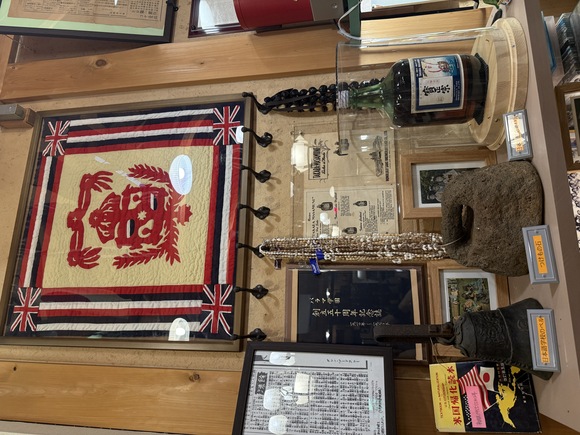
Items on view at Nihojimamura Hawai‘i Emigration History Museum, October 2025
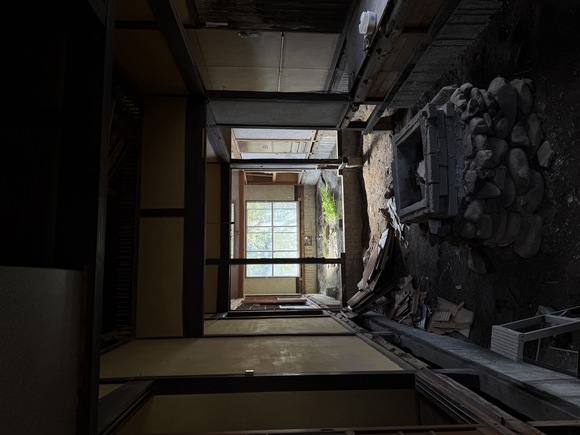
Site visit with Yellow River College, October 2025
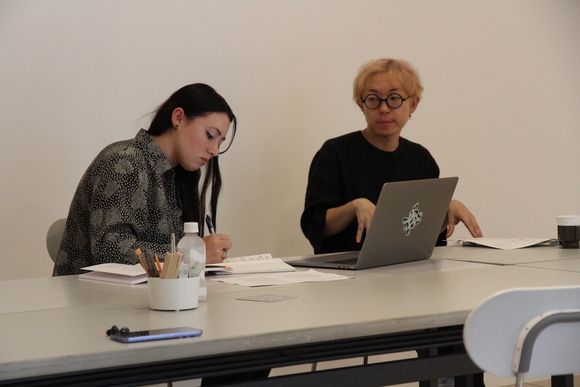
Mentoring Session with Yamamoto Hiroki
Outcome of the residency
This residency arrived at exactly the right moment in my research. Many works central to my research were on view, and I finally encountered pieces I had only seen online or read about. Seeing them in person shifted my focus to their materiality, scale, and spatiality—elements that will inevitably impact the texture of my future writing. As my first institutional residency, TOKAS gave me a sense of how an artistic ecosystem forms: the pace of daily work, how one introduction can lead to another, and word-of-mouth information shaping the movements of a network. It felt grounded but precarious in a way that mirrored my research on collectivity—studying it while actively relying on it. Gaining contextual knowledge about Japanese emigration opened new pathways for considering diaspora experiences and for future collaborations with Nikkei and Pacific-diasporic artists. I only wish I could have stayed the full three-months.
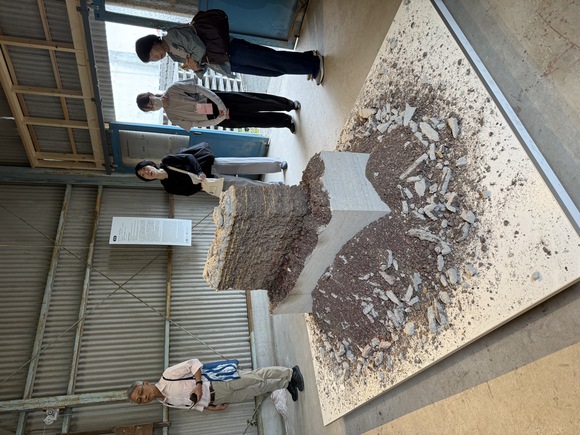
Installation view of What Lies Within (2025) by Robert Andrew, Aichi Triennale 2025
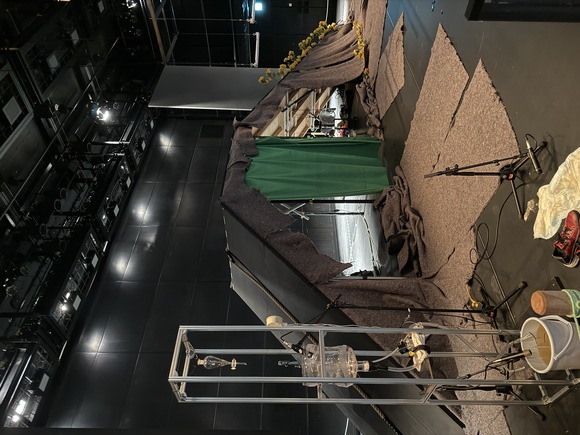
Stage Design for Eternal Labor, performance by OLTA, Aichi Triennale, 2025
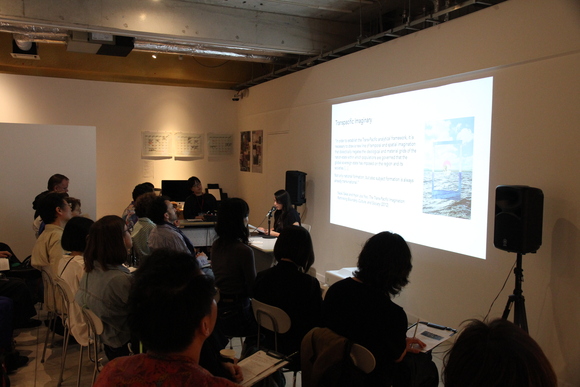
Curator Talk Volume 8
Our Facilities