Katherine BALL
Katherine BALL
update: 2026.9.7
Profile
Born in Detroit, USA in 1983. Lives and works in Berlin. Graduated with a Master of Fine Arts in Art and Social Practice from Portland State University in 2012. Master of Environmental Management from Yale University School of the Environment in 2022.
Katherine Ball is a habitat for fungi and bacteria located on planet Earth. Based in Berlin, she is an artist working across water, inflatable sculpture, illustration, and writing.
Recent activities
2026 “Mirror Barricade,” collaboration with Tools for Action, Stedelijk Museum, Amsterdam, The Netherlands
2026 “Resource Management: Prototype for greywater filtration and recycling,” Center for Media Arts ZKM, Karlsruhe, Germany
2026 “Onsen sur Loire,” collaboration with Alexis de Raphelis, Benoît Verjat, Claire Boitel, Anne Chaniolleau, and Claire Perspicacius, Quarante-sept Deux, Cosne sur Loire, France
2025 “The Water Runs Through Us,” The Goethe Institute, Nancy, France
2025 “Contaminations: Bodies Between Nature and Culture”, Künstlerhaus Stuttgart, Stuttgart, Germany
Awards
2018-present, Member of Floating University Berlin Association, winner of the New European Bauhaus Award 2023 and winner of the Golden Lion Award at the Venice Architecture Biennale 2021, in collaboration with raumlaborberlin and Hausderstatistik, ZUsammenKUNFT Berlin e.G.
2018 German Chancellor Fellowship, Alexander von Humboldt Foundation, Berlin
2015 Fulbright Fellowship, US Fulbright Program, Copenhagen
About works
Infrastructure is a complex network of fundamental systems and machines that are under us, over us, and around us. Often working as quietly as the concerted heartbeats of millions, infrastructure shapes the way people live and who we are. Yet how often do we wonder if it could be different? Katherine Ball works with the medium of water as an infrastructure—and as a social, cultural, and ecological medium that connects human and more-than-human worlds. Rather than treating water as an invisible utility or technical problem, her work asks how changing our relationship to water might transform our relationships with each other and the environments we share. Filtration systems become a way of making those relationships visible and experiential.
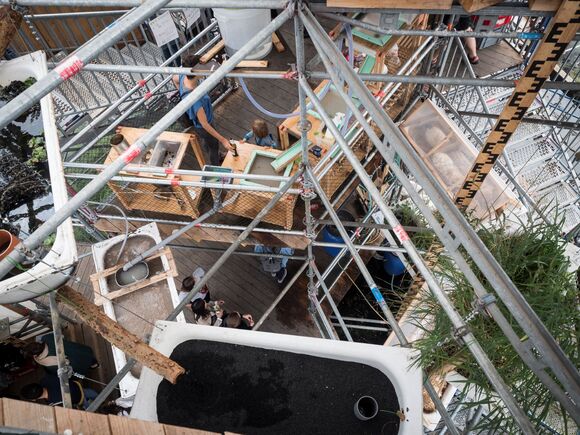
“Water filtration system at Floating University Berlin,”2018, Water (greywater, rainwater, and basinwater), bathtubs, sand-biofilm, activated carbon, zebra mussels, plants, mushroom mycelium, straw, moving bed reactor, bacteria. 30 x 30 x 30 meters (filtration system)
Collaboration with Raumlaborberlin (Architects and project initiators) and Floating University e.V. Association (current project team).
An experimental water filtration system and campus located in a concrete basin that collects the stormwater runoff from the former Tempelhof Airport.
Location: Floating University (Berlin, Germany), Photographer: Daniel Seiffert
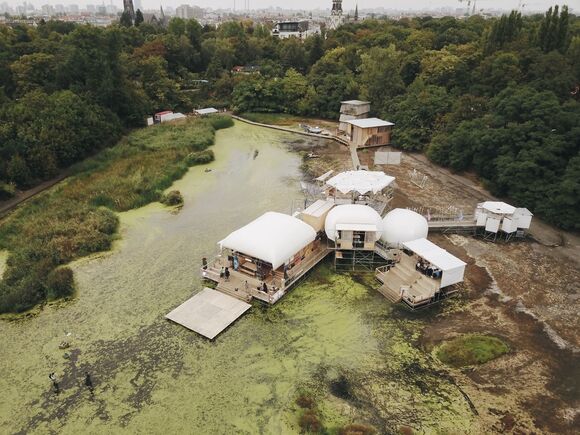
“Water filtration system at Floating University Berlin,”2018, Photographer: Alexander Stumm.
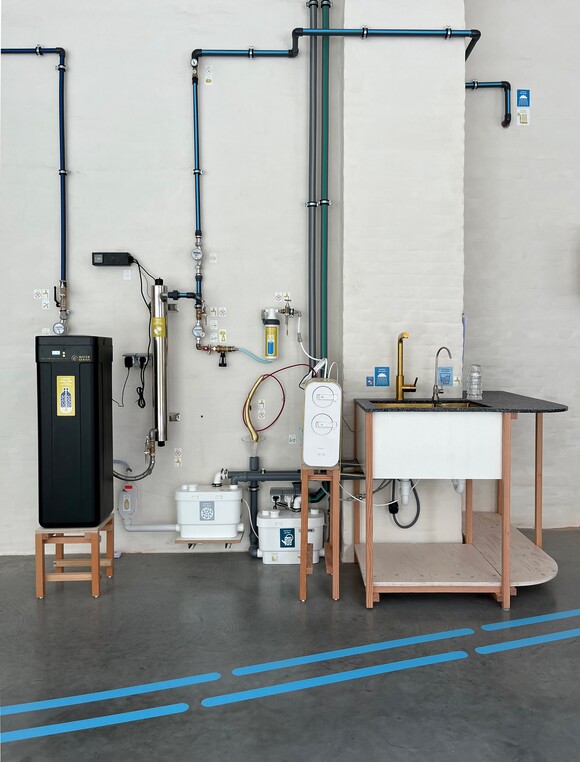
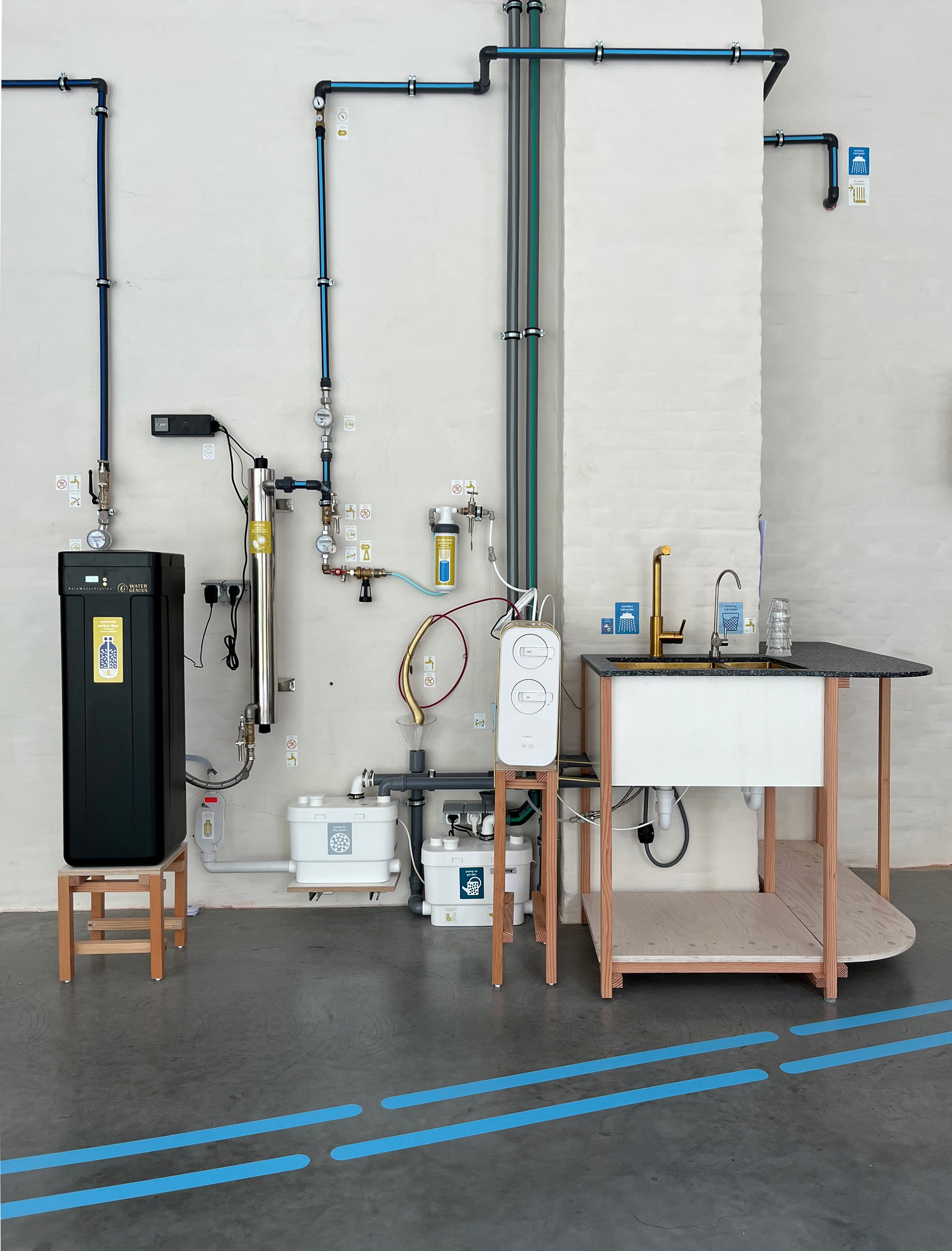
“Rainwater Filtration System,” 2023, Rainwater, activated carbon, limestone, UV light, membrane filter, reverse osmosis filter, sink, water collectors, cistern, plastic and copper pipes, compressor. 0.75 x 2.5 x 0.75 m (section of filtration system pictured), 50 m x 10 m x 50 m (entire system).
A filtration system that turns rainwater into drinking water and sanitary water. Rainwater from the roof of the art center, is collected, filtered, and then pumped through the entire building for use.
Location: Timelab Arts Center (Gent, Belgium)
Photographer: Katherine Ball
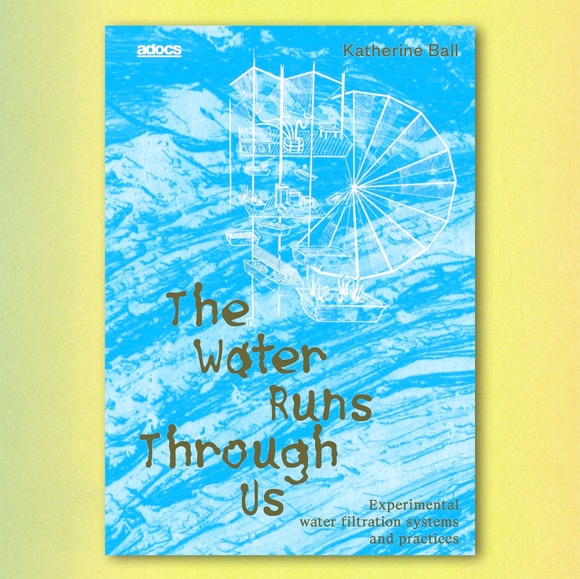
“The Water Runs Through Us,” 2025, Book, softcover. Pages: 220. Size: 21 × 15 × 1.5 cm. A book about experimental water filtration systems and practices. Published by adocs.
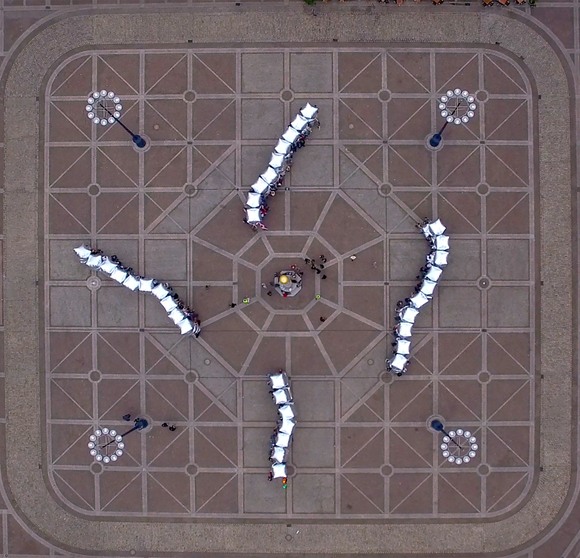
“Mirror Barricade,”
2016, Silver insulation foil. mirror foil, double stick carpet tape, velcro, duct tape, plastic valves, 12 V fans, 12 V batteries. 140 cm3 (size of individual cobblestone), 109 cobblestones total. Collaboration with Tools for Action (project team: Bambí Benkö van Balen, Tilly Gifford, Cami Martenot, and Katherine Ball).
A social sculpture made of modular, silver-reflective inflatable cobblestones that can be assembled into a barricade within seconds. It was created in collaboration with Theatre Dortmund, local secondary schools and the wider public in response to the annual far-right march Tag der deutschen Zukunft ("The Day of German Future"), which was scheduled to take place in Dortmund.
Location: Public space, Schools without Racism—Schools with Courage Network, Theater Dortmund (Dortmund, Germany), Photographer: unknown (cc) Tools for Action
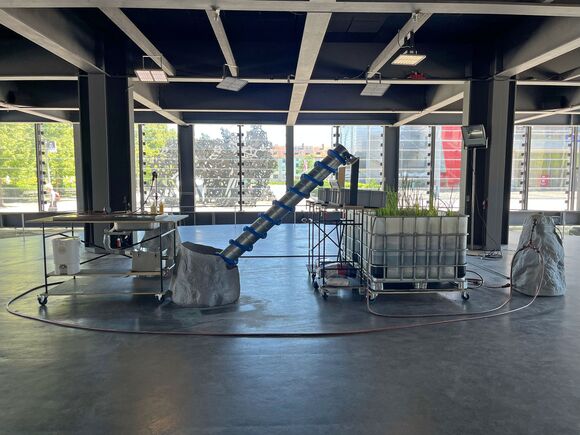
“Resource Management Prototype: Greywater Filtration System,”
2026, Greywater, sink, grease trap, sand, oolite, zeolite, biochar, vermiculite, perlite, plants. 6 x 2 x 4 meters.
An experimental artwork simulating sustainable water recycling for the MARS project (Mobilizing Awareness for Resilient Societies), exploring resource efficiency in confined environments. Designed as a recirculating system, it treats greywater (non-potable) from dishwashing using a sink, grease trap, and layers of sand, oolite, zeolite, biochar, vermiculite, and perlite located in substrate filters. In October, the artwork will be used by three astronauts for a 10-day mission living inside a habitat on MARSplatz.
Location: The Center for Media Arts ZKM (Karlsruhe, Germany)
Photographer: Katherine Ball
Our Facilities