Mei LIU “Homesick for Another World: a film unfolding in space”
- TOP >
- Archives >
- Exhibitions / Performances >
- Mei LIU “Homesick for Another World: a film unfolding in space”
Mei LIU “Homesick for Another World: a film unfolding in space”
OPEN SITE 10 | Open Call Program【Performance】
Traversing various societies, time periods, and political struggles, Mei Liu
stages interdisciplinary multimedia performances in which past, present,
and future overlap. Her storytelling performances interweave documentary
footage, oral histories, dreams, detective fiction, and personal reflection
in unexpected ways. She draws connections between collective
consciousness, memory, and contemporary technology, exploring the
theme of dreaming under oppressive conditions with both humor and
insight.
| Date | Nov 7 (Fri), 2025 19:00- Nov 8 (Sat), 2025 14:30- *Post-show talk|Moderator: LI Yinong (Researcher) (With Japanese-English Interpretation) Nov 9 (Sun), 2025 15:00- |
|---|---|
| Ticket | 2,500 yen - Booking required, all seats are unreserved. - Booking opens from 14:00 on Sep 12 (Fri), 2025. - Booking will close if seats are sold out or at 17:00 the day before the performance. |
| Venue | Tokyo Arts and Space Hongo: Space C (3F) |
| Writing / Performers | Mei LIU, Malaz USTA |
| Support | Forecast Mentorship and mentor SHIGA Lieko, Amarte Fonds, Electric Shadows studio |
| Installation collaboration artist | MEI Xinyi |
| Ticket information | - Booking for the performance on Nov 7 (Fri), 19:00- is closed. A few tickets without reservation are available at the door 1 hour before the performance (cash only). - Booking for the performance on Nov 8 (Sat), 14:30- is closed. A few tickets without reservation are available at the door 1 hour before the performance (cash only). - Booking for the performance on Nov 9 (Sun), 15:00- is closed. A few tickets without reservation are available at the door 1 hour before the performance (cash only). |

Ticket bookings available from 14:00 on September 12 (Fri)!
Go to the booking website (Peatix).
*Peatix account required to book tickets.
*Research developed under the framework of MA Artistic Research in and through Cinema, Netherlands Film Academy.
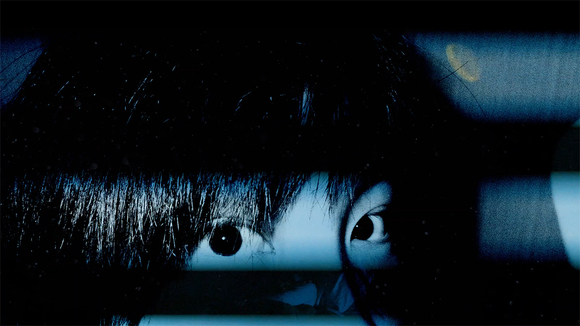
Homesick for Another World 2024
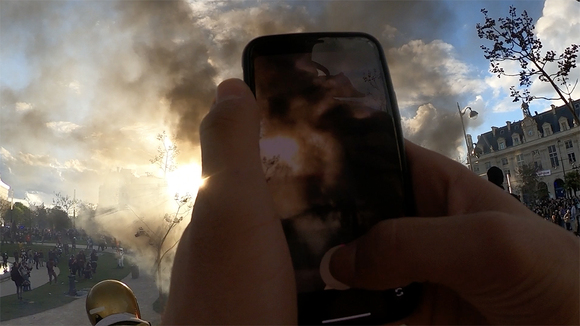
Homesick for Another World 2024
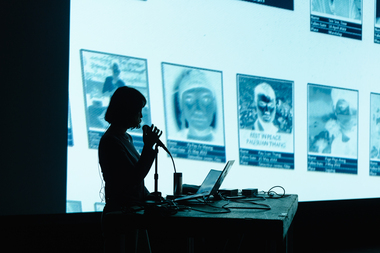
Homesick for Another World 2025
Photo:Yutaro Yamaguchi ©︎Theater Commons Tokyo’25
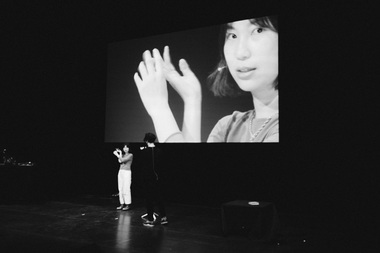
Homesick for Another World 2025
Forecast Festival 2025 © Camille Blake
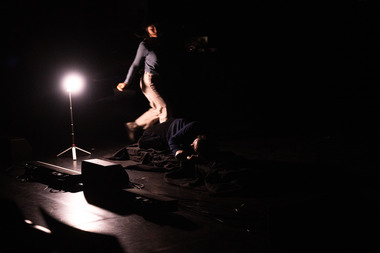
Homesick for Another World 2025
Forecast Festival 2025 © Camille Blake
Profile
Mei Liu is an artist, filmmaker, and performance-maker from Shanghai, who is now based in Amsterdam. With a
background in documentary and fiction filmmaking, she integrates these methodologies into her performances,
expanding the definitions of cinema and practicing “film yoga” as a means of gaining spiritual insight into herself and
the world through mindful films and performances. Recent activities: “Homesick for Another World (performance),”
Theater Commons Tokyo/Forecast Festival, Berlin, 2025.
https://meiliulc.com/
Review
escaping to a dream (for subterraneans)
HATANAKA Minoru (OPEN SITE 10 Jury member)
The lecture-performance titled Homesick for Another World is an iteration of a long-term, research-based project by Mei Liu, born in Shanghai, China, and Malaz Usta, born in Syria. It takes as its point of departure a lecture-performance prototype produced by Liu last year with photographer Shiga Lieko as her mentor, after Liu was selected for the German artist development program Forecast Mentorship. The cinematic performance explores whether it is possible to escape from the reality in which the artists live (a reality that might also be our own). It also reflects on dreams as a way of inhabiting another reality, and as a means of approaching utopia by breaking free from the bonds of everyday life. The project has taken different forms with each presentation, including screenings, installations, workshops, and publications. For this performance at TOKAS, it was presented as a lecture-performance that interwove lecture and footage of talks, blurring the distinction between documentary and fiction while powerfully conveying just how malleable our world can be.
The project has its origins in the lockdowns during the COVID-19 pandemic. Caught in the draconian lockdown in Shanghai, Liu was able to leave a solitary quarantine area with the help of her mother. Having departed while her family stayed behind, she came to perceive a dual reality in which her doppelganger had never left. Now living in a very different place, Liu conducted interviews with people who remained in China, including friends and family, researching how they lived under quarantine and which survival and coping strategies they employed. Drawing on these experiences gathered in the form of an oral history, the project seeks a way out of realities defined by isolation or political repression. It gradually zooms out from Liu’s personal experiences to the testimonies of others who were quarantined, and to broader stories of people confronting oppressive realities.
These people discovered dreaming as a means of resistance. Their escapes into the world of dreams, where one is free of all confinement, offer glimpses into the histories underlying each individual’s personal narrative. These dreams clearly reflect their desire for release during quarantine. For those living under imposed isolation, dreams keep hope alive by enabling them to inhabit another world that begins to seem more real than this one. Liu has said that she came to “believe that experiences in dreams are in fact actual experiences.” This conviction emerged through the practice of lucid dreaming as a mode of combating oppression in the “real” world. This was an endeavor to escape the mental confinement produced by physical lockdowns in China.
Usta lived in Syria, a country that suffered under the dictatorial Assad regime for 50 years. A civil war erupted in 2011, and the dictator eventually fled in 2024, after which a provisional government was established the following year. Usta recalls this as a moment of long-awaited freedom and renewed hope, but because that freedom came before a shared vision for Syria’s future had taken shape, discrimination and internal conflict continued. In the talk, Liu explained that lucid dreaming serves as a metaphor for the capacity to make choices based on individual agency. After Syria’s liberation, how would people act on their newfound agency? Even if each individual cherishes a vision of an ideal future, further problems arise when those visions fail to converge. This connects to another core concern of the project: Is a world in which individual dreams and ideals are shared even possible? This question is by no means posed from a hopeless or nihilistic standpoint, but instead points to the eternal question of how (an ideal) democracy might be realized.
Among the various directorial techniques used, the footage appears in negative in some sections in order to protect the privacy of activists from Myanmar. Liu touched on the possibility that the world of dreams might look like this, employing a photographic metaphor to suggest that the negative image represents a reality that has not yet been “developed” (or “printed”). Unprinted film stored in a lightless box remains in a state full of potential. This, she noted, corresponds to the non-realization of dreams, in that once a dream comes true it is no longer a dream.
In scenes where live images of the performer are projected onto the screen during her performance, slightly shifted viewpoints and life-sized scale cause reality to appear doubled, seen from two different angles at once. This enables the audience to directly sense the dream-within-a-dream state being described at that moment. The concept of physical engagement with the image also recalls the use of live video in the performances of Joan Jonas. In the talk, Liu explained that in earlier works she projected larger-than-life images on screens taller than herself, but this seemed to produce an effect similar to political propaganda. In this iteration, she says, projecting images at roughly life size made it possible to introduce a layered reality that more strongly evokes lucid dreaming.
HATANAKA Minoru
Curator, Critic of Music and Art. Born in 1968. Involved with the NTT InterCommunication Center [ICC] prior to its opening in 1996, serving successively
as Senior Curator and later as Head of the Curatorial Department, before departing the institution at the end of March 2025. Recent exhibitions: “Tribute to RYUICHI SAKAMOTO: Music/Art/Media,” 2023, “evala: Emerging Site/Disappearing Sight,” 2024.
Participating Creator
Our Facilities