Annie Jael KWAN
- TOP >
- Archives >
- Residency Program >
- Annie Jael KWAN
Research Residency Program
update: 2020.2.4
Annie Jael KWAN
| Participating Project | Research Residency Program |
|---|---|
| Activity Based | Singapore/UK |
| City | Tokyo |
| Period | 2020.1- 2020.3 |
Purpose of the residency
My residency with TOKAS will provide me with the opportunity to research and think through more deeply the questions I have regarding reconfiguring a notion of 'future feminism'. I am keen to explore how artists in Japan have encountered and responded to 'feminism', both as a Euroamerican construct as well as a locally contextualised adaptation - are feminist ideas and values relevant in the Asian context?
Plan during the residency
- meet and interview key artists and collectives
- explore alternative artistic and exhibition archives via the artists and collectives
- survey in major art museums and institutions how gender and feminism is portrayed and discussed in contemporary art exhibitions and events
- develop a deeper understanding of the socio-historical specificities in the development of modern and contemporary Japanese art, that form the context of this research
Activities during the residency
During my research residency at TOKAS from 27 January to 31 March 2020, I undertook the following activities with several aims: I wanted to ask how might the question of futuring feminism might be framed within the Japanese context through its artists and performative art practices, as well as gain a wider understanding of Japanese institutions, art networks and cultural heritage. For these aims, I spent my time visiting a range of art-related sites including art galleries and their archives, museum institutions, universities, alternative art and creative spaces. I also viewed art exhibitions, and historical and cultural heritage sites. Specifically for my project, I met and interviewed a wide range of feminist artists whose intergenerational and interdisciplinary approaches have provided a multi-layered perspective on feminism. In addition, I also developed the opportunity to widen my professional network in Japan and beyond, by meeting other art professionals, and developing strong relationships with my TOKAS colleagues.
Overview of the residency
My research was very productive in that I gained understanding of the history of feminism and feminist art in Japan via a range of intergenerational and interdisciplinary artist perspectives, with a focus on performativity, which has given my confidence to begin developing a curatorial transnational feminist art project with Japanese artists. In addition, I have built a very viable professional network in Tokyo and beyond, with potential collaborations. It is difficult to determine what I might have done differently, as my residency work was interrupted somewhat by the pandemic and lockdown. Various museums and sites I had planned to visit towards the end of March were closed, and due to the difficulty of organizing my transits back across to Singapore and London, my stay in Tokyo was prolonged. However as things begin to open up again, I intend to pick up some of those loose ends in the work.
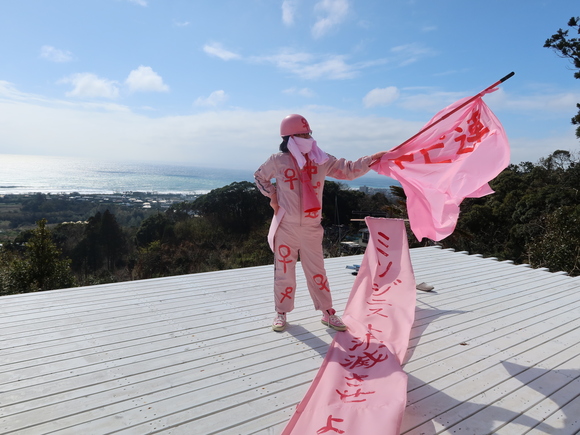
In tribute to International Women’s Day, artist and activist scholar Yoshiko Shimada pays homage to Chu-pi-ren (a radical women’s group in the early 1970s) with a banner that references Matsuzawa's ‘banner of disappearance’. (Image by Annie Jael Kwan, 2020)
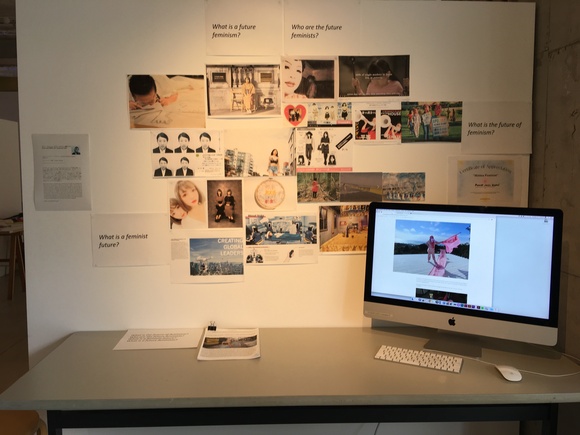
Research mapping of Future Feminism, 2020 (Installation view at OPEN STUDIO)
Our Facilities