MINO Arata
- TOP >
- Archives >
- Residency Program >
- MINO Arata
Exchange Residency Program
(Japan-based Creators sent abroad)
update: 2026.6.29
MINO Arata
| Participating Project | Exchange Residency Program (Japan-based creators sent abroad) |
|---|---|
| Activity Base | Tokyo and Kanagawa |
| City / Place stayed | Seoul / SeMA Nanji Residency |
| Period | 2025.3 - 2025.5 |
Purpose of the residency
The former Yongsan U.S. military base, which was originally a Japanese military base taken over by the U.S. forces, ceased operations by 2024 and is gradually being opened to the citizens of Seoul. However, the contaminated land that should have been restored upon its return by the U.S. military remains unresolved, left in a "suspended" state. This situation represents a political issue rooted in the U.S.-ROK SOFA (Status of Forces Agreement) and serves as a symbol of the historical shifts in the ownership of land and people by nation-states. At the same time, it raises the question of whether our bodies, which should be free, can truly find comfort on "suspended" land as long as they remain subject to sovereign states. Building on themes I have explored in Japan, creating work in Seoul—a place with a similar status agreement—enables a multifaceted artistic approach to issues surrounding military bases and war.
Plan during the residency
- Month 1: Conduct research at and around the former Yongsan U.S. military base, exploring potential narratives. Additionally, I aim to interview people who worked at the base and residents in the surrounding area.
- Month 2: Begin the creation of a play while organizing collaborative workshops with local artists and performers based on the developing work.
- Month 3: Present a provisional outcome using a studio visit or a temporary space such as a gallery. Specifically, I plan to conduct a tentative "performance" based on the research findings.
- Foster exchanges and collaborative opportunities with interdisciplinary artists based in Seoul.
Activities during the residency
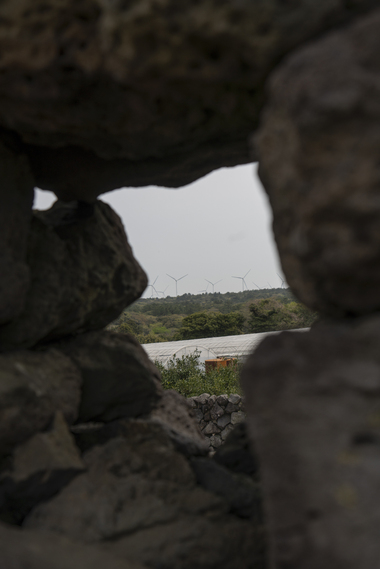
Initially, I conducted research from a cross-cultural perspective on the history and current state of the U.S. military
base in Yongsan. However, during preparations for an exhibition in Seoul, I witnessed the unauthorized removal of
a participating artist’s mural, which forced me to reconsider my own positionality and sense of ethics. As a visitor
from outside, I found myself caught between the distance of an outsider and the immediacy of someone present at
the scene, confronting my role and involvement. Focusing on the themes of "walls" in the city, "layers" of history,
and “정/ 情” in relationships, I explored the intersecting structures of colonialism, militarization, and artistic
practice through fieldwork, photography, dramaturgical imagination,
and dialogue with others, seeking points
where complex voices converge.
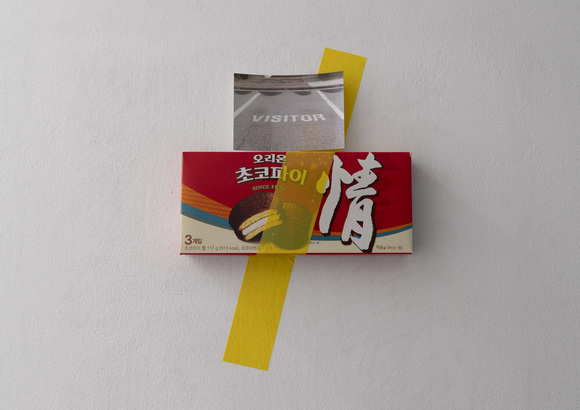
OPENSTUDIO Installation view,2025 installation, mixed media (photographs, masking tape, Choco Pie, barbed wire from the DMZ)
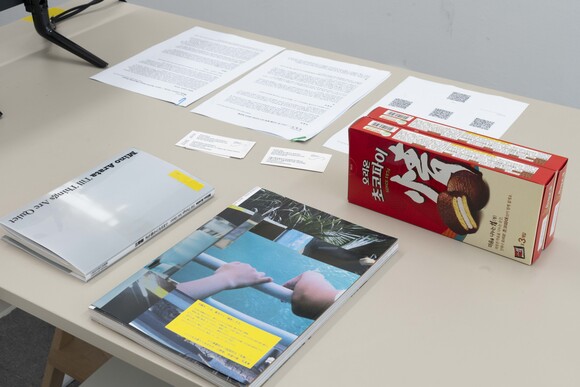
OPENSTUDIO Installation view,2025,installation, mixed media (photographs, masking tape, Choco Pie, barbed wire from the DMZ)
Outcome of the residency
The greatest outcome of my residency was physically sensing the historical and geographical continuity between
Japan and Korea. The tactile details I gathered— not only at memorial sites but also in everyday landscapes—
connected abstract concepts to my own narrative. Encounters with artists and independent curators of my
generation produced a strong chemistry and are already turning into future collaborative projects.
In the open
studio I tested a flexible display: photographs temporarily fixed with yellow masking tape and a QR text that
updates in real time, keeping the creative process visible. The installation also wove in my intervention and self reflection
on a later-mentioned mural-erasure incident, so that my own position within structural violence became
part of the work.
My main drawback was the limited time to commit deeply to a single site, yet the human network I built now
makes longer stays feasible. The experience not only influences my practice but also prompts a rethink of modern
Japanese history, propelling me toward the next project: mapping and dramatizing “walls and jeong” across East Asia.
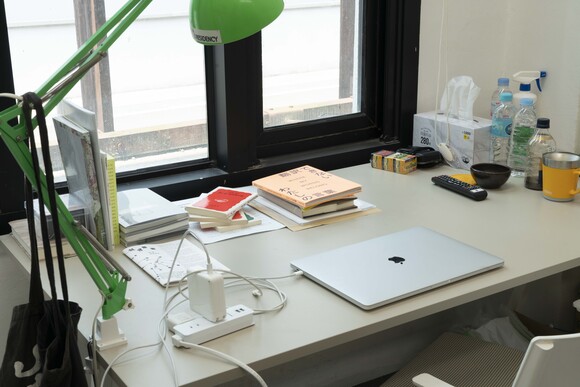
OPENSTUDIO Installation view,2025,installation, mixed media (photographs, masking tape, Choco Pie, barbed wire from the DMZ)
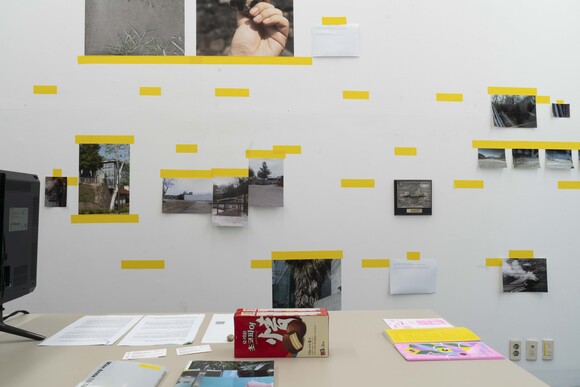
OPENSTUDIO Installation view,2025,installation, mixed media (photographs, masking tape, Choco Pie, barbed wire from the DMZ)
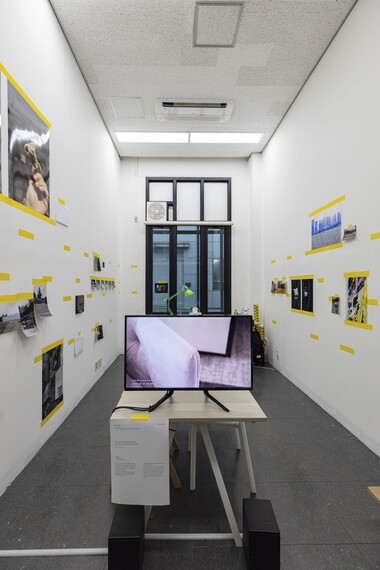
OPENSTUDIO Installation view,2025,installation, mixed media (photographs, masking tape, Choco Pie, barbed wire from the DMZ)
Photo by Sustain
Works(Courtesy by Nanji Residency,Seoul Museum Art)
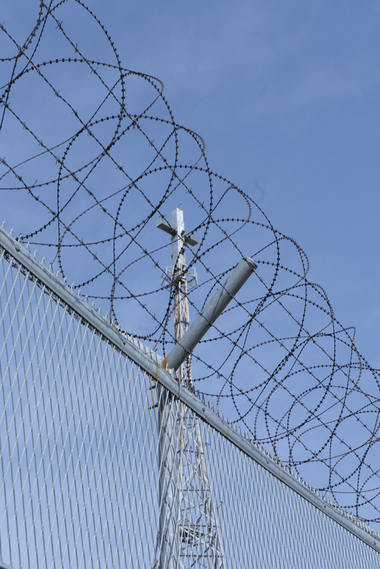
The state of the research
The state of the research
Our Facilities