HALA Saori
- TOP >
- Archives >
- Residency Program >
- HALA Saori
Exchange Residency Program
(Japan-based Creators sent abroad)
update: 2025.8.13
HALA Saori
| Participating Project | Exchange Residency Program (Japan-based Creators sent abroad) |
|---|---|
| Activity Based | Japan |
| City / Place stayed | Taipei / Treasure Hill Artist Village |
| Period | 2025.9 - 2025.11 |
Purpose of the residency
To further develop "P wave," a dance project that reinterprets the body and society shaken by earthquakes through a choreographic lens, I will conduct research across various cities in Taiwan. Like Japan, Taiwan is a seismically active region, and I aim to observe its disaster history, urban planning, and advanced technologies for disaster prevention. At the same time, I will explore more embodied and ancestral responses to disaster, such as traditional ritual dances and spiritual practices. Through dialogue and field observation with local communities, the project seeks to trace connections to East Asian cosmologies of nature and the body, and to explore sensory modes of response and perception shaped by life on shifting ground.
Plan during the residency
- Seismic Observation & Disaster Education: This section investigates the systems and technologies of seismic observation and disaster education in Taiwan. It includes observation of how knowledge is transmitted in institutions such as the Central Weather Administration and disaster education centers, as well as how social frameworks for responding to seismic activity affect bodily perception. The research also focuses on technologies that allow for simulated, embodied disaster experiences, such as earthquake simulators. Planned visits: Central Weather Administration (Seismic Center) / Taipei, Taipei Disaster Prevention Science Education Center / Taipei, 921 Earthquake Museum of Taiwan / Taichung (Wufeng)
- Architecture & Infrastructure: This section explores the intersection between modernization and disaster preparedness through earthquake-resistant buildings and urban infrastructure developed during the Japanese colonial period. It focuses particularly on architectural and urban design strategies that integrated disaster responses into their structures, such as banks, government facilities, and city planning, and considers how those strategies continue to shape contemporary urban space in Taiwan. Planned visits: National Taiwan Museum (Land Bank Exhibition Hall) / Taipei, Taipei City Wall / North Gate / Taipei
- Religious Rituals: Government Memorial This section observes traditional religious practices and spiritual beliefs in Taiwan that have been used to respond to disasters such as earthquakes and epidemics. The focus is on embodied rituals such as spirit possession, soul-calming ceremonies, and City God worship in Taoist temples, and how these practices relate to collective memory and emotional responses to disaster. Planned visits: Longshan Temple / Taipei, Dihua Street & Xiahai City God Temple / Taipei, Xingtian Temple / Taipei, King Boat Festival (Donggang) / Pingtung, Jitong (Spirit Medium Practices) / Tainan, Penghu, and other regions
- Folk Performance & Embodied Practice: This section explores collective bodily expressions surrounding disaster and death, such as Zhong Kui dance and Zhen Tou (temple parade) performances. Special attention is paid to the ritualistic and commemorative structures within these performances, and how they serve as modes of remembering and reorganizing disaster through the body. Planned visits: Temple Festivals (Miao Hui) / Taipei, Zhong Kui Dance (Exorcism Dance) / Tainan, Zhen Tou (Temple)
- Reconstruction & Spatial Reorganization: This section investigates post-earthquake housing, markets, and urban areas to explore how communities rebuild themselves and their memories in the aftermath of disaster. The research focuses on how spatial transformations affect the sensory and physical dimensions of everyday life. Planned visits: Post-disaster Public Housing / Markets / Taipei, Earthquake Ruins / Hualien Harbor / Hualien
Activities during the residency
As part of the development of the performance project "P wave," which explores the coexistence of bodies and societies with natural disasters, I undertook a research residency in Taipei.
During my stay, I conducted field research at a museum established as an educational district in the area affected by Taiwan’s largest earthquake, the 1999 “921 Earthquake.” I also investigated earthquake-resistant infrastructure in urban areas and carried out interviews with Indigenous communities living in mountainous regions. Through these activities, I examined how disasters are experienced, remembered, and integrated into daily life in Taiwan.
For the exhibition, I presented an archival display of P wave alongside an outdoor performance version of the work. Throughout the research and production process, I engaged in continuous dialogue with Taipei-based dancers and artists. These exchanges contributed to a deeper understanding of embodied perspectives rooted in Eastern philosophy and nature-based belief systems.
Outcome of the residency
The Resident Artist Exhibition at Treasure Hill Artist Village featured archives of “P wave” which previously presented performance in Japan, along with a video based on it. This marked a step in the work-in-progress process of transforming the performance into an exhibition. Through repeated exchanges and discussions with Taiwanese curator River Lin, I consulted with him on future activities and project developments in Asia, and had a chance to participate in a talk event at the Taipei Performing Arts Center. Through conversations with Maria Hassabi, an artist active internationally moves between theater and art museums, I gained insights for my future work. I became able to view my works and research, which originated from themes specific to Japan, within a broader context. Experiencing traces of the Japanese colonial era in my daily life was a significant experience and provided an opportunity to reexamine the history of colonial rule in East Asia. Furthermore, participating in a group exhibition with visual artists allowed me to explore the possibilities of expression that are not dependent on theatrical spaces.
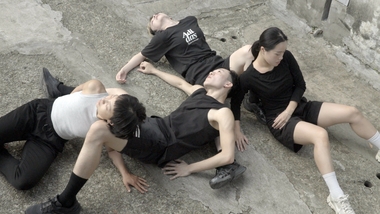
"P wave Taipei WIP"2025, Performance, 20min
Photo: Peng Ying Cheng
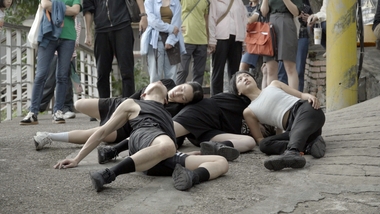
"P wave Taipei WIP"2025, Performance, 20min
Photo: Peng Ying Cheng
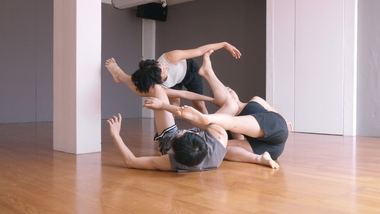
《P wave Taipei WIP》2025, Single-channel video, 6min
Photo: Peng Ying Cheng
Our Facilities